Writing
W hat do we want our children to learn?
The writing curriculum at All Saints Academy is guided by the National Curriculum for English (2014). At All Saints Academy it is our intent to provide high quality learning experiences to develop children’s competence in both transcription and composition. It is essential that teaching develops children’s competence in these two dimensions. In addition, children should be taught how to plan, revise and evaluate their writing. These aspects of writing have been incorporated into our writing curriculum for composition.
Writing down ideas fluently depends on effective transcription: handwriting and spelling. Children need to know the relationship between sounds and letters (phonics) and understanding the morphology (word structure) and orthography (spelling structure) of words. Writing also depends on fluent, legible and, eventually, speedy handwriting.
Effective composition involves articulating and communicating ideas, and then organising them coherently for a reader. This requires clarity, awareness of the audience, purpose and context, and an increasingly wide knowledge of vocabulary and grammar.
What does writing teaching and learning look like at ASA?
RWInc Get Writing
The Read Write Inc Get Writing! scheme is used from Reception to Year 1 to embed the basic skills of writing in a clear, structured way. Children are taught to form letters correctly, build simple sentences, and use sounds they know to spell words accurately. Lessons are carefully sequenced so that pupils move from oral rehearsal to writing with confidence, gradually increasing independence. By revisiting and practising these core skills regularly, the scheme helps children develop a strong foundation in writing that prepares them for more complex composition as they progress through school.
Writing post Get Writing
Place Value for Punctuation and Grammar (Grammarsaurus PVPG) is used at the start of each year group, from Year 1 (after Get Writing!) through to Year 6, to secure and build writing basics in a consistent, progressive way. The approach revisits and deepens pupils’ understanding of sentence structure, punctuation, and grammar by organising skills into clear “place value” steps that match each year’s expectations. This ensures that key basics are reinforced before new content is introduced, allowing children to consolidate prior learning, address gaps, and develop confidence and accuracy in their writing as they move up through the school.
Writing is taught within specific, meaningful, and effective contexts. We underpin our writing lessons with high-quality texts and/or curriculum led stimulus. Children have focused daily writing lessons which follow a clear sequence within a unit.
Frequent opportunities to write are also planned across the curriculum.
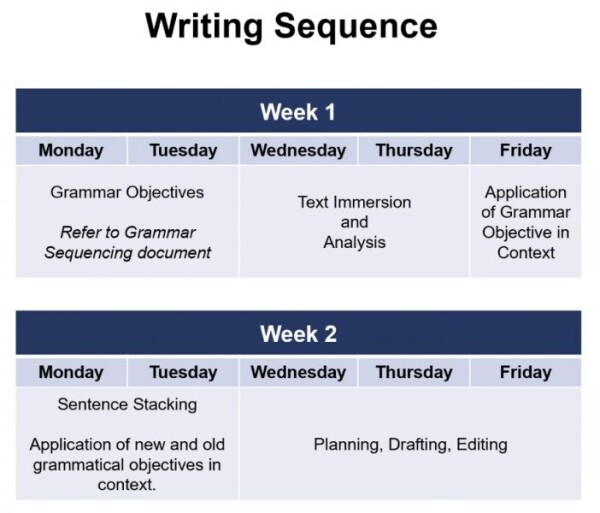
Writing genres have been planned out across Key Stage 1, Lower Key Stage 2 and Upper Key Stage 2. Key Stage One focus on ‘Writing to entertain’ and ‘Writing to inform’ only. These strands are also repeated in lower and upper key stage two. ‘Writing to persuade’ is introduced in Lower Key Stage Two and ‘Writing to discuss’ is introduced in Upper Key Stage Two.
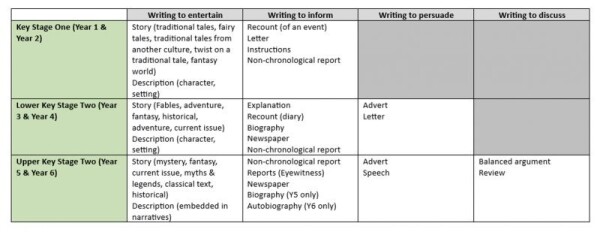
Grammar objectives are taught explicitly at the start of a writing unit. These skills are initially taught out of the text type context to reduce the cognitive load on children. These skills are then applied within the text type context following text immersion and analysis.
Children are immersed in high quality model texts which are analysed in depth through high quality discussions. Children discuss the purpose and audience of the text and the key features. This deep understanding of the texts enables children to make specific grammatical and language choices within their own independent writing. When writing an independent piece, the following process is followed:
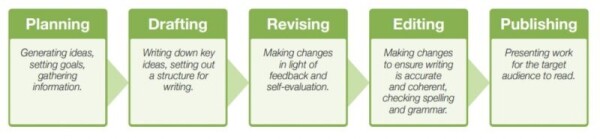
Once children have written an independent piece, they have the opportunities to reflect on and improve writing through revising and editing. Children also have the opportunity, at least once a term to publish a final piece of writing.
 Spelling skills are developed using a phonics-based approach in line with the requirements of the English National Curriculum. Teachers follow a clear spelling long term plan which plots out which spelling rules to teach each half term. Children practice spellings daily.
Children are taught to use a neat and consistent style of handwriting using the Read Write Inc resources (Letter Village).
What is the impact of our writing curriculum?
At All Saints Academy, writing is assessed formally each term using clear assessment criteria. Teachers use the assessment information to inform any intervention required and inform future plans.
Children will be equipped with a strong command of the written world and acquire a wide vocabulary, an understanding of grammar and knowledge of linguistic conventions for writing. Pupils will write clearly, accurately and coherently, adapting their language and style in and for a range of contexts, purposes and audiences.
Key documents/links
- Development Matters (Non-statutory curriculum guidance for EYFS): For Writing related content go to Section 6 , p59- ‘Physical Development’ and Section 7, p74 – ‘Literacy’
Development Matters - Non-statutory curriculum guidance for the early years foundation stage